The Growing Legacy of the Denver Cherry Creek Rotary Club
By Robert Mintz, Charter Member
Where It All Began
As Denver Cherry Creek Rotary ( DCCR) approaches its 40th anniversary, it’s a great time to reflect on the legacy projects that helped shape our club. These stories remind longtime members of what we’ve accomplished—and introduce newer members to the spirit of service that has defined DCCR from the beginning.
Our club began meeting in 1987 and was chartered in 1988. One of our first international service projects was a commitment to fund “Village Banks” in Guatemala.
John Hatch, a former Peace Corps volunteer, founded FINCA, an organization based on the micro-finance model pioneered by Muhammad Yunus and the Grameen Bank in Bangladesh. The idea was simple: providesmall loans—particularly to women who lacked access to traditional banking—to help them start businesses and improve their families’ lives.
In 1989, John Hatch spoke to DCCR. We were so impressed that we literally “passed the hat” and raised $1,000 to fund a village bank, with a commitment to contribute another $9,000 over the following years.
At the time, DCCR had no foundation and very little money. We were essentially hand-to-pocket-to-project—but that didn’t stop us.
I helped start the club because Rotary gave me a way to pursue my passion for international service. Since Ihad started a travel agency in 1987, I had access to free airline tickets. Combined with my Spanish skills, this allowed me to visit our village banks in Guatemala every six months and report back to the club.
I saw firsthand how these small businesses improved the lives of borrowers and their children.
Then a sharp-eyed young dentist, Scott Johnson, noticed something else in my slide presentations: ourVillage Bank members had very limited access to dental care.
And that’s how the DCCR dental mission began.
Following Our Money
By 1990, DCCR had invested $13,000 with FINCA, supporting village banks in Guatemala, Peru, and Ecuador. We later conducted dental missions in those same communities, following one of our club’s guiding principles:
Always follow our money.
Recently, I contacted FINCA to find out what that original investment might have accomplished. RobertPrice, FINCA’s Director of Development, estimated that our contribution could have supported thousands of loans over the years and, at any given time, helped approximately 26 borrowers.
Based on FINCA’s benchmarks, those borrowers could have generated approximately $78,000 in additional income over 30 years and supported employment for roughly 34 people.
Whatever numbers you choose to use, the message is the same:
A small investment can create a very big legacy.
What began with a $1,000 contribution, a “pass the hat” moment, and a group of determined Rotarians became the beginning of an international service legacy that continues today.


 For years, Angalia Bianca had slept in abandoned buildings throughout Chicago. She stole. She did drugs. She spent time in and out of jail for forgery, theft, trespassing, and possession of narcotics. But after she landed in prison for the seventh time, something changed -- Bianca knew she wanted a better life. She just didn’t know how to make it happen.
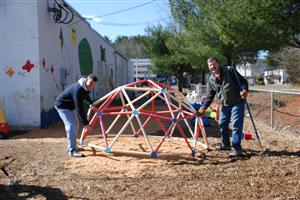 What is it like taking a large team to Africa? It has probably been one of the most rewarding experiences in my life. In mid February, I began leading Rotary members from all over the East Coast of the United States through Ghana. I’ve tried to give the team a warm Ghanaian welcome like I’ve received on my earlier trips. A large trip is a real blessing because each person sees Ghana and our work in a different way.
 Throughout India and around the world, Rotary clubs are celebrating a major milestone: India has gone three years without a new case of polio. The last reported case was a two-year-old girl in West Bengal on 13 January 2011. To mark this historic triumph, Rotary clubs illuminated landmarks and iconic structures throughout the country with four simple but powerful words, "India is polio free."